
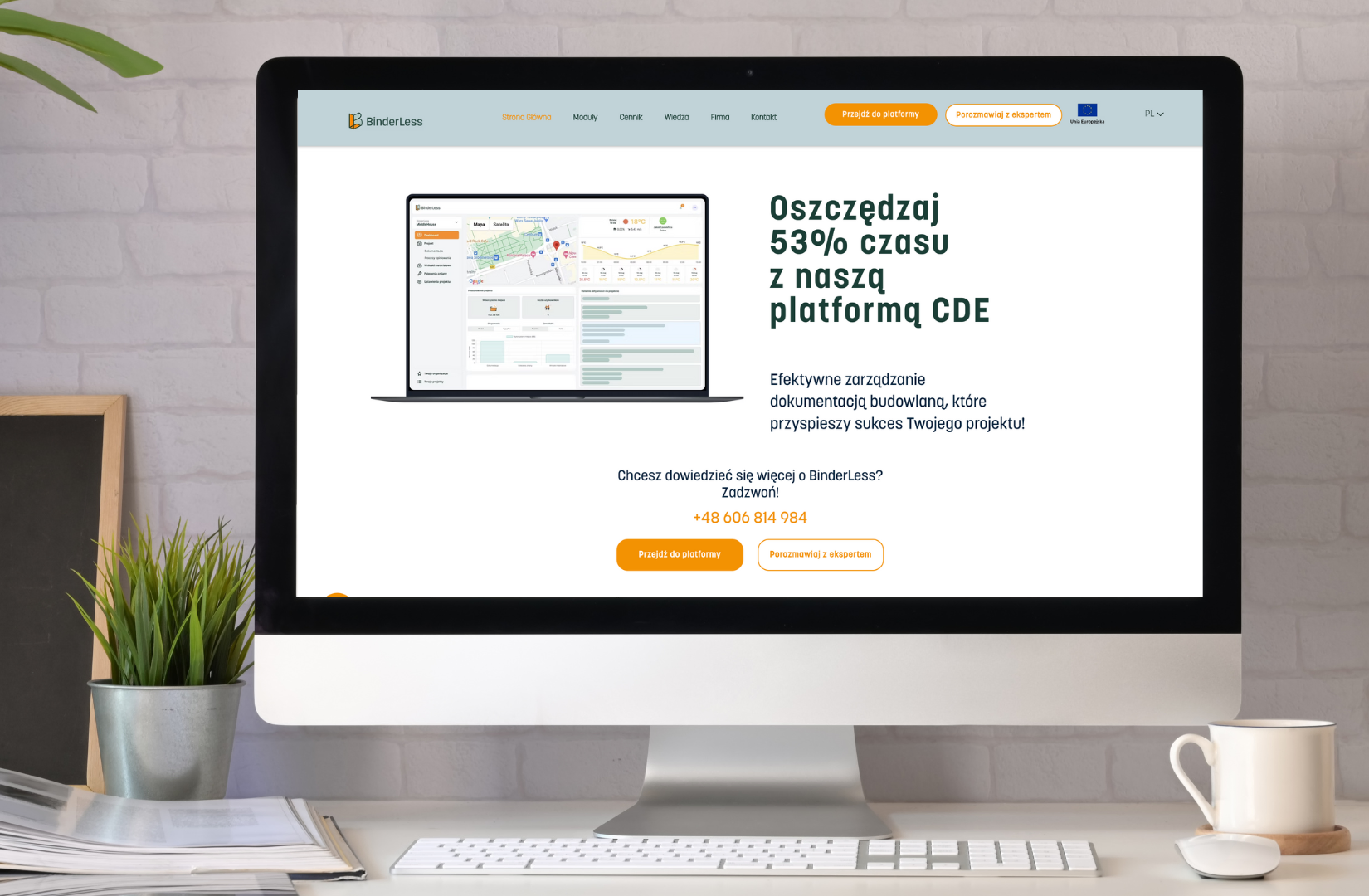
Construction is changing before our eyes. Although it remains one of the most traditional industries, the need for digital transformation is becoming increasingly evident – not only in design or execution of works, but above all in information management. Why is this so important? Because in everything we do – from the initial concept to the final acceptance – information is the most crucial. Its quality, completeness, and accessibility determine whether a project runs smoothly or sinks into chaos of misunderstandings.
This is why there is increasing talk about the need to implement coherent, transparent, and accessible workspaces for everyone – such as CDE platforms. Their role is growing because more and more participants in the investment process are beginning to understand that it's not just about storing files, but about building a collaborative environment. An environment where it's easier to communicate, make decisions, draw conclusions, and simply build better.
What exactly is CDE?
CDE, or Common Data Environment, is a shared space for managing information throughout the lifecycle of a construction investment – from concept, through design, execution, to operation. This concept was defined and popularized in the international ISO 19650 standard, which describes information management in processes using BIM models. CDE is therefore not a trendy add-on, but a fundamental element of a well-organized approach to project management in construction.

The main task of CDE is to collect, organize, and share data in one place – in a controlled, accessible manner, adapted to the roles of participants. It's not just about storing files or versioning documents. It's about creating a work environment where all process participants – investors, designers, contractors, supervisors, subcontractors, property managers – have access to information created by others, to be able to perform their part of the work as best as possible.
Each of these participants contributes something to the project, but to act effectively, they need to understand the context – decisions, arrangements, drawings, documentation. CDE enables access to this information in real-time, in an organized manner, and without the need to search through dozens of emails or folders.
Importantly, CDE doesn't mean everyone sees everything. On the contrary – a well-designed environment provides access to what a specific user needs, with the ability to delve into details when necessary. Such selective transparency is of great value – it allows maintaining order while not limiting access to knowledge.
CDE is also a tool for making better business decisions. When information is current, reliable, and readily available, decisions are made faster, more accurately, with less risk of error. In the world of construction, where each day of delay can mean losses, and every mistake – costly corrections, this has a real impact on the financial result and reputation of the entire team.
Why is Information the most Important Thing We Have?
On every construction site, information is key. Even the best-organized team cannot execute a project efficiently if someone is working with outdated data or doesn't have access to necessary documents. It's from such small information gaps that bigger problems begin – delays, errors, corrections.
The vast majority of difficulties in construction projects stem from communication or information gaps – not from incompetence, but from lack of transparency. CDE helps to organize this chaos. It facilitates quick access to needed information, and consequently – allows for better decisions to be made faster and with less risk. When data is readily available, unnecessary questions, ambiguities, and doubts are avoided.
Equally important is the ability to measure and analyze. CDE not only organizes documents but also creates an information trail – who, what, when, why. This is the foundation for drawing conclusions and improving processes. Without data, nothing can be changed – and if we want to build better, we need to know what works and what doesn't. That's why collecting information during the investment is not an add-on, but a necessity. Because it's insanity to do everything the same way and expect different results.
Benefits of Using CDE
- Organized access to information CDE centralizes project data in one place, eliminating the need to use scattered communication channels (email, phone, local drives). Each participant has access to the current version of documents, drawings, decisions, and comments – without the need to search for them.
- Transparency and control Every change is recorded: who, what, and when modified. This facilitates risk management, supports compliance with procedures, and enables quick reconstruction of the decision-making process in case of disputes or errors.
- Process standardization Defined approval paths, repeatable folder structure, and uniform document formats reduce errors resulting from information chaos. They also make it easier to onboard new team members.
- Data-driven decisions Access to current and historical data enables decision-making based on facts, not intuition. CDE supports progress analysis, identification of bottlenecks, and drawing conclusions for future projects.
- Support for the entire investment lifecycle The CDE platform supports not only the design and execution phase but also the handover of as-built documentation and facility operation. Data is not lost – it becomes a knowledge base for the manager, service, and future modernizations.
- Risk minimization Availability of the right information at the right time reduces the risk of wrong decisions, design collisions, and costly changes on the construction site. The sooner a problem is identified, the cheaper its solution.
- Time and cost savings CDE shortens the time needed to obtain information, speeds up document approval, and reduces duplication of activities. The result is greater operational efficiency and better budget control.
Real-life Examples: What Does a CDE Platform Change?
CDE platforms are best understood in action. Below are three short scenarios that show the difference between the traditional approach and working in a CDE environment.
Comparison of work with and without CDE on a construction site – information chaos versus organized access to data.
Case 1: Missing Assembly Detail
Without CDE:
The contractor emails the designer asking about a missing detail. The designer reads the message with a delay, searches for documentation on their own drive, comes back with questions. The final answer comes after a few days — too late. Work is suspended, resulting in time and financial loss.
With CDE:
The request goes directly to the document with precise location. The designer receives a notification, opens the request on their phone, responds the same day. The decision is automatically archived in the system. Work continues without interruptions.
Case 2: Approval of Material Submission
Without CDE:
The subcontractor sends a material submission as an Excel attachment. The investor doesn't know which file it is, has no context of location. Email exchanges ensue. After a week, the submission is approved — but the order is already late. Delay in delivery = shift in work schedule.
With CDE:
The submission is made in the system – linked to a specific location and scope. The investor sees it immediately, can compare with the project and approve with one click. Response time: 1 day. Delivery as per schedule.
Case 3: Conflicting Document Versions
Without CDE:
At the coordination meeting, it turns out that part of the team is working on last week's version of the drawing. One discipline introduced changes, but they weren't passed on. Result: collisions, delays, and searching for "who approved which version".
With CDE:
Each document has one active version – approved, marked, with change history. Older versions are archived but not available for further work. Everyone works on the same basis, and the coordinator sees who and when made changes.
Who Uses CDE and how?
Investor
- Has constant access to current documentation, decisions, and schedules — in one place.
- Can review and approve documents directly in the system (authorization paths).
- Tracks submissions, inquiries, and approvals in real-time, which facilitates investment control.
- Uses an organized information archive — useful for settlements, acceptances, and planning future projects.
Designer
- Submits documentation for review and authorization according to established approval paths.
- Receives design inquiries from contractors or investors and responds in one system, without the need for separate emails.
- Locates documents in relation to each other (e.g., discipline project vs. architecture), which helps avoid collisions.
- Has full control over versioning and access to their materials.
General Contractor
- Works on approved, current versions of documentation – eliminates the risk of mistakes "on old drawings".
- Can submit design inquiries and material submissions directly in the platform, assigned to specific documents or locations.
- Receives decisions and opinions in a structured way, with action history.
- Checks documentation completeness and quickly locates missing or inconsistent elements.
Subcontractors and Suppliers
- Receive only the part of documentation that concerns them – along with status information (under review, approved, to be corrected).
- Can raise questions and clarifications for specific documents or locations (micro-communication).
- Submit material submissions and await approval or correction – all in one system.
- Their actions are recorded and assigned to specific stages or scopes of work.
Investment Supervision
- Review and comment on documentation directly in the system – with the ability to add contextual notes and comments.
- Track contractor submissions, work progress, acceptance protocols.
- Locate documents in the context of the investment (e.g., reference of sanitary project to floor or building zone).
- Monitor statuses of submissions, decisions, and materials approved for implementation.
Property Manager
- Takes over complete as-built documentation in an organized and standardized manner.
- Can easily locate specific design studies or technical documentation for a given installation, premises, room.
- Has access to submissions and intervention history from the construction stage – which facilitates diagnosis of operational problems.
- Can also initiate service inquiries and submissions in the system in the context of existing documentation.
CDE Platform as a Communication Space
Modern construction projects require communication on many levels – both micro (tasks, changes, submissions) and macro (team coordination, investor decisions, work progress). CDE serves as a digital space that combines all these dimensions in one environment.
1. Micro communication — contextual and task-oriented
The platform enables communication directly with specific documents, locations, or project elements.
- Submissions and inquiries are assigned to a drawing, floor, scope of work.
- Users receive notifications only about matters that concern them.
- Every comment, response, or decision is recorded — with date and author.
2. Macro communication — full picture of the investment
From the CDE level, you can track:
- document statuses and their approvals,
- number of open submissions and inquiries,
- activity of individual participants.
Such a cross-sectional view facilitates risk management and identification of delays or problems before they affect the entire investment.
3. Shared space, different access levels
Each user sees exactly what they need for work — no more, no less.
- The designer has access to documents they create and coordinate.
- The subcontractor sees only approved data concerning their scope.
- The investor can check the status of all documentation or delve into details of individual disciplines.
This avoids information overload and maintains order without limiting transparency.
4. Open but controlled communication
CDE is not about chaotic "file dumping" – every piece of information goes through a specific path: submission, approval, sharing. Comments are recorded, decisions are archived, and all actions have an audit trail. This eliminates disputed situations and strengthens responsibility for information.
Why Choose a Platform like BinderLess?
BinderLess is a modern CDE environment that responds to the real needs of the construction industry. It combines a proven structure based on the ISO 19650 standard with features that the competition simply doesn't offer – especially in the area of artificial intelligence utilization.
What Distinguishes BinderLess from other Platforms:
- Industry context – a platform created with construction in mind, not as a general-purpose tool. It focuses on key investment processes.
- Intuitive interface – designed for users with varying levels of technical experience. It can be used without training or long implementation.
- Very fast project launch – folder structures, roles, access, approval paths – everything ready to use within hours, not weeks.
- Built-in AI search engine – the user doesn't need to remember file names or locations. The system understands context and finds information even inside files as if talking to an engineer.
- Automatyzacja procesów z wykorzystaniem uczenia maszynowego – BinderLess wspiera m.in . klasyfikację dokumentów, uzupełnianie metadanych, analizę statusów i kompletności.
- Automatic carbon footprint calculation – already at the stage of material submissions, which supports ESG compliance and sustainable development strategy.
- ISO compliance – the entire document structure, workflow, and access management are compliant with ISO 19650, which facilitates implementation for institutional investors.
BinderLess doesn't just organize information – it understands it, analyzes it, and helps manage it. Thanks to this, CDE ceases to be a digital archive and becomes an active participant in the investment process.
Summary
CDE platforms are no longer an add-on today, but the foundation of effective information management in construction. They allow avoiding chaos, speed up actions, minimize risk, and increase transparency of work across the entire team. However, implementing the tool is just the beginning.
The biggest challenge is not technology – but changing the approach. We need to stop treating information as a by-product of the process and start seeing it as its basis. Because if you don't measure something, you can't change it. And it's insanity to expect better results by doing everything the old way.
BinderLess supports this change — not only by providing a platform but by helping to build a new work culture. Based on collaboration, transparency, and data. That's all – and that's enough.
W tym artykule
- What exactly is CDE?
- Why is Information the most Important Thing We Have?
- Benefits of Using CDE
- Real-life Examples: What Does a CDE Platform Change?
- Who Uses CDE and how?
- CDE Platform as a Communication Space
- Why Choose a Platform like BinderLess?
- Summary
- Zobacz inne artykuły które mogą Cię zainteresować
- What if I told you that a document management platform is more than just code and procedures?

In the era of digitalization in the construction industry, the Common Data Environment (CDE) is becoming a key tool supporting processes.

In the era of construction digitization, data has become one of the most valuable organizational assets. Project documentation, BIM models, reports, and schedules - all this information determines the smooth progress of investments, and their loss or leak can mean millions in losses, delays, and loss of client trust. It is therefore no wonder that the question "how to protect data in the cloud?" becomes one of the key challenges for managers and IT specialists.

For 28 years, Marvipol Development has been one of the leading Polish residential developers, and as industry pioneers, they are not afraid to introduce modern solutions to improve the management of their projects.