

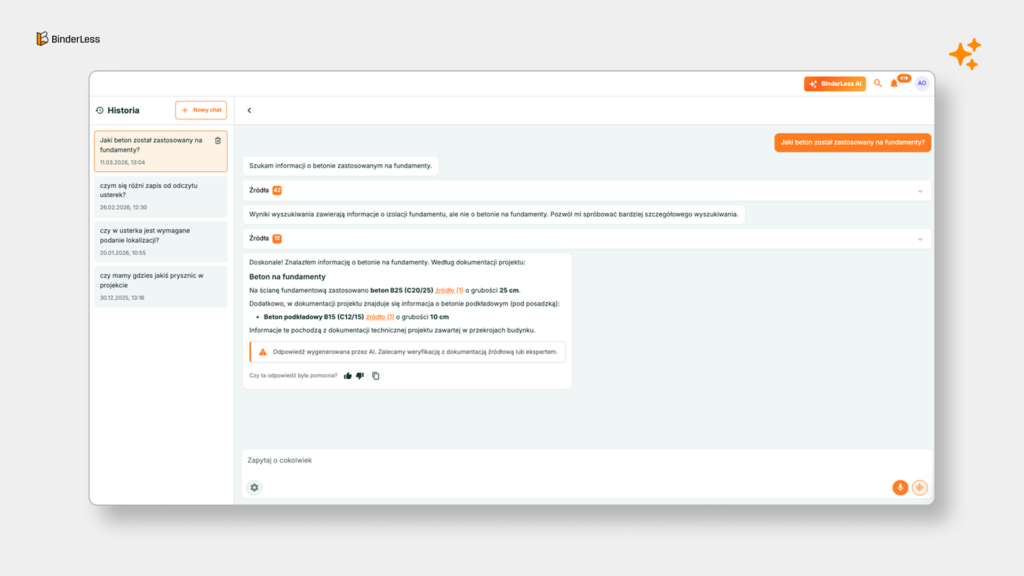
The BinderLess AI Agent is the first CDE (Common Data Environment) solution with built-in artificial intelligence for the construction industry. It combines RAG architecture with full project documentation, allowing engineers to ask questions in natural language and receive answers based on real project data – not guesswork.
AI in construction: a revolution that starts with documentation
AI in construction: a revolution that starts with documentation
Artificial intelligence is increasingly entering construction sites. However, the real change doesn’t start with robots or drones, but with… documents. This is where project managers, inspectors, and engineers lose hours of work every day – hours that can be reclaimed.
BinderLess introduces a solution that can change this – the world’s first AI Agent fully integrated with a construction documentation platform (CDE). With it, teams can simply talk to their documentation and get answers in seconds that previously required tedious searching through hundreds of files.
Before we look at how our AI Agent works, it’s worth understanding the basic concepts behind its capabilities. In this article, we explain the fundamentals of artificial intelligence that form its foundation – such as LLM, RAG, visual grounding and self-reflection loop – and show how they translate into real benefits in daily work on the construction site and in the design office.
According to a McKinsey report, employees spend an average of 1.8 hours a day solely searching for information – almost a quarter of their entire workday. In the construction industry, where project documentation consists of hundreds of files in dozens of versions, this problem is particularly acute.
Source: McKinsey – The Social Economy
BinderLess Agent vs. NotebookLM – which AI tool will work in construction?
Google’s NotebookLM is a popular tool for working with documents – but will it work on a construction site? Here are the key differences.
| Criterion | BinderLess AI Agent | Google NotebookLM |
|---|---|---|
| Integration with construction documentation | Native integration with the CDE platform – the Agent works directly on project documents (drawings, specifications, RFIs) | Requires manual file upload; no integration with a CDE system |
| Source of answers | Answers based solely on project documentation with exact source and page provided | Answers based on uploaded files, without project context or versioning |
| Risk of hallucinations | Minimal – the Agent quotes a specific document fragment and indicates its location (visual grounding) | Possible with incomplete input data; no verification mechanism with the project |
| Document version control | Automatic – the Agent always works on the current document version approved in the CDE | None – the user must ensure the uploaded files are up-to-date |
| Voice interface | Yes – you can talk to the Agent vocally and dictate questions | No native voice interface in the standard version |
| Access control | Answers filtered according to the user’s role in the project (manager, inspector, contractor) | No role system – anyone with access to the notebook sees all data |
| Reading scans, stamps, and photos (OCR) | Yes – the Agent reads document scans, stamps, and photos from the construction site thanks to built-in OCR and multi-modal reasoning | Limited – NotebookLM primarily processes text; scans and images require prior conversion |
| Creating reports and automation | Yes – the Agent creates reports, defect reports, and documents directly in the project without manual form filling | None – NotebookLM does not integrate with any reporting system or document workflow |
| For whom? | Project managers, supervision inspectors, developers managing multiple projects simultaneously | Individual users analyzing their own documents; project work without a multi-user environment |
The main difference lies in the context: NotebookLM analyzes the documents you provide. The BinderLess AI Agent understands the project – its structure, versions, roles, and change history.
According to Mastt’s analysis, implementing AI solutions can increase productivity in construction by 31% by 2030, while reducing project costs by up to 20%.
What exactly is AI – and how does it work in practice?
Artificial Intelligence (AI) is a broad set of technologies that allow computers to perform tasks requiring human-like intelligence. This can include language understanding, i.e., reading comprehension, image recognition, data analysis, or decision-making.
AI Agent from BinderLess
An AI Agent is a specific type of AI that not only processes information but acts with a specific purpose, responds to user queries, and makes decisions in the context of a given task. For the Construction AI Agent, this means:
- Understanding natural language questions – you can ask, for example, “What is the heat transfer coefficient for the window in zone C?” and the Agent will understand the meaning of the question.
- Data search and analysis – The AI Agent from BinderLess searches through project documentation in the CDE platform, combines different sources, and generates a response based on actual data, not assumptions.
- Contextual interaction – The Agent remembers the project context, user role, and previous queries to ensure responses are precise and useful.
- Information supplementation and generation – In later stages, the Agent will be able to create reports, suggest problem solutions, or automatically fill in missing data in documents.
In short: AI in the form of an Agent not only answers questions but becomes an active partner in the work process, helping to save time, avoid errors, and efficiently manage documentation.
LLM as the foundation for the AI Agent in construction
LLM is the foundation of AI Agents and serves as its “language brain”. Thanks to it, the Agent can converse in natural language, interpret user intentions, and generate readable responses, which are then supported by actual data from project documents.
LLM – definition and capabilities
LLM, or Large Language Model, is a type of artificial intelligence that can understand and generate natural language. These are machine learning models trained on enormous text datasets (books, articles, websites), through which they learn:
1. Statistical relationships between words and sentences
The model knows which words and phrases usually occur together and in what context. Here’s a simpler example from construction, showing statistical relationships in LLM: “On the construction site, it’s best to keep a helmet on …” – The model looks at statistical relationships in the training data. Most often after such a beginning, the following appear:
- “head” – 12%
- “desk” – 8%
- “shelf” – 4%…
- “lynx” – 0%
Statistically, in texts about safety, helmets are most often kept on the head, so the model will most likely complete the sentence with the word “head”. In short: LLM chooses the answer that most often appears in a similar context in the training data, even if there are other possible variants.
Fun fact
* This is a simplification, as the model also takes into account temperature, which is a parameter controlling the randomness (i.e., “creativity”) of how subsequent words are selected. If the temperature is 0, the model will always choose the word with the highest probability, there’s no randomness here. If temperature = 1, the model sometimes chooses a different word — still probable, but not always the same, making its responses more natural and varied. The higher the temperature, the more creative and unpredictable the model becomes, but at the same time, the risk increases that the answer will be less sensible or less factual.
| Temperature | Randomness | Response style | Example |
|---|---|---|---|
| 0 – 0.3 | No randomness | precise, repeatable | On the construction site, it's best to keep a helmet on your head |
| 0.3 – 1 | Standard balance | natural, balanced | "head — not under your arm or in the car." |
| > 1 | High randomness | creative, surprising, sometimes chaotic | "dog, because it always guards the tools." |
2. Creating coherent responses
It can generate sentences that are logically correct and sensible in a given context. This means that the model can not only choose individual words but generates entire, coherent sentences or paragraphs in response to questions. For example:
- “How to prepare the substrate for a concrete screed?”
- “The substrate should be cleaned of dust and loose elements, the surface should be leveled and moistened with water to ensure proper adhesion of the concrete.”
This answer is logically correct and sensible in the context of the question, even if the model hasn’t seen this exact project. LLM combines fragments of knowledge from various documents and patterns, creating a comprehensive, understandable description of the action.
3. Understanding user intent
Thanks to patterns in the text, the model can assess what the user is asking about, even if the question is not formulated perfectly precisely. For example:
- To the question: “What margins for windows?”, which is informal and abbreviated, the model “guesses” based on training data that the word “margins” in the context of “windows” usually refers to allowable installation tolerances and based on this knowledge generates the answer:
- “The allowable tolerances for window installation in masonry walls are usually ±5 mm, depending on the standard and type of construction.”
In short: LLM can “filter” imprecise or abbreviated questions and interpret them correctly, providing a sensible and useful answer.
In practice, LLM operates in two stages:
- Input – the model receives text (e.g., a question, document fragment).
- Output – the model generates a response, predicting subsequent words based on what it learned during training.
Examples of LLMs include Chat GPT from Open AI, Gemini or Notebook LM from Google, and Claude from Anthropic.
Language models (LLM – Large Language Models) are systems that can analyze text, recognize context, and provide responses in a way that is natural to humans. In simple terms – AI doesn’t “know” everything, but it understands language, intentions, and the meaning of words in context, allowing it to respond as an expert from the team would.
RAG in Construction – Intelligent Responses Based on Documentation
Despite the fact that LLM is trained on large datasets, it doesn’t “know” anything about specific project documents – it operates based on patterns from training data, meaning it lacks context for a specific construction. For the Agent to be useful in construction, it’s necessary to combine the LLM system with the Retrieval-Augmented Generation (RAG) system.
What is RAG?
RAG is a technique that combines large language models (LLM) with the ability to access external information sources, e.g., project documentation. Thanks to this, the AI Agent doesn’t rely solely on training patterns but refers to specific, real data, providing precise answers.
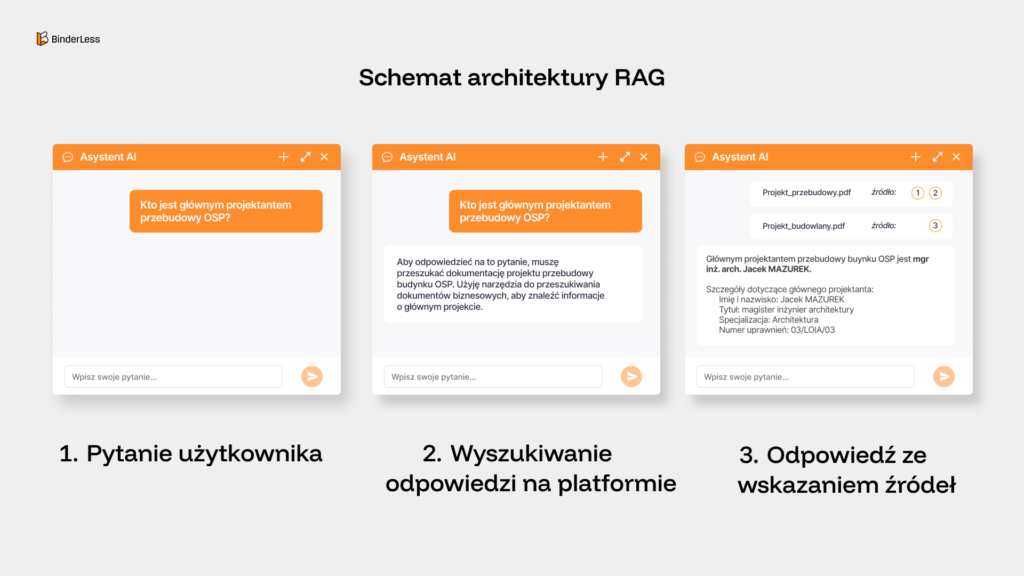
In practice, RAG works like this:
- User query goes to the LLM, which interprets the question’s intent and formulates a “contextual query” to the database or project documents.
- Retrieval – the system searches the documentation in the CDE platform, selecting fragments most related to the question.
- Augmented Generation – LLM combines its linguistic knowledge with the found fragments and generates a full, coherent response, linked to actual documents.
Thanks to RAG, the AI Agent:
- doesn’t “hallucinate” answers – it always refers to the source,
- provides precise and up-to-date information, even if the documentation is scattered,
- allows the user to ask questions in natural language and receive answers consistent with the project and standards.
In practice, this means that:
- LLM interprets and processes language – it understands questions in natural form, even imprecise or abbreviated ones.
- RAG provides precision and project context – the Agent refers to actual document fragments in the CDE.
Without LLM, the Agent wouldn’t be able to converse in natural language – it would be just a document search engine. Without RAG, LLM would generate responses based only on statistical patterns, which could lead to errors in the context of a specific project.
AI Agent Connected to the CDE Platform – why is it Important?
In construction, language understanding alone is not enough. What matters here is data – drawings, documentation, specifications, dozens of file versions. That’s why BinderLess based its AI Agent on the RAG architecture.
Now that we’re aware of what LLM is and why without proper RAG (retrieval-augmented generation) the answers would be imprecise, it’s worth understanding what connecting such an AI Agent with a CDE (Common Data Environment) platform provides.
Unlike a regular GPT chat, which can answer general knowledge questions, the AI Agent in CDE uses current, verified project documentation, allowing it to provide precise, contextual answers tailored to a specific building and its data. When you ask, for example, “What is the heat transfer coefficient for the window in section B2?”, the Agent analyzes the documentation, finds the appropriate fragment, cites it, and provides the source. It doesn’t guess. It really knows where the information comes from.
In practice, this means that artificial intelligence in construction projects can become an active participant in the information flow – one that understands documents, connects data, and provides answers within seconds.
Self-reflection Loop and Visual Grounding – how AI Learns to Understand Projects
Connecting the AI Agent with the CDE platform opens up entirely new possibilities, going beyond a regular GPT chat. Thanks to integration with full project documentation and visual construction data, the Agent not only answers questions but can understand the project context, indicate connections between documents, and support real-time decision-making.
Understanding the basic concepts and operation of the AI Agent, we can now focus on several advanced features that make its use truly practical in everyday work: from visual reference to documentation, through self-correcting conclusions, to intelligent information linking and proactive suggestions in the project.
Additional Concepts Related to the Functioning of the AI Agent
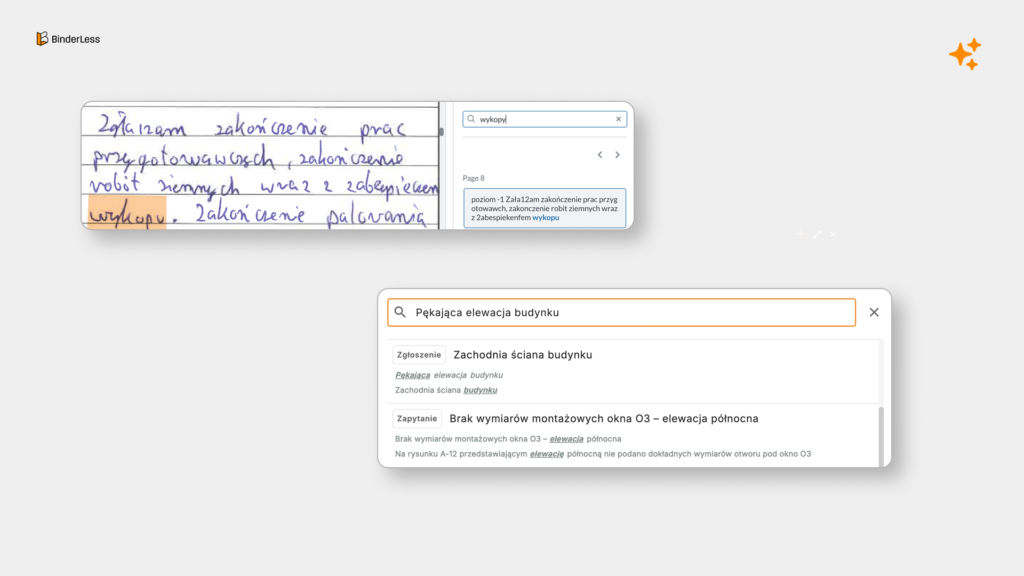
Visual grounding – AI’s ability to link text with an image or document fragment. In practice, this means that the AI Agent doesn’t just say “the coefficient is in the table on page 42”, but shows the exact fragment of the document where this information is located. This allows the user to immediately verify the answer and be sure it comes from the right source. In the context of construction, this is a huge change. Instead of searching through hundreds of PDF pages, the Agent visually indicates the place it’s talking about. This speeds up work, reduces errors, and builds trust in the data.
Example: you ask “Where is the electrical installation conduit in the basement?” and immediately get a highlighted fragment of the floor plan.
Self-reflection loop – The biggest difference between traditional search and an intelligent AI Agent is that the Agent doesn’t stop at the first answer found. Instead, it analyzes its own conclusions, checks their accuracy, and – if necessary – searches further and corrects.
Example: it detects an inconsistency in the specification and suggests a correction in the response.
Smart linking / dynamic citation – AI’s ability to create hyperlinks and references to exact fragments of documentation. In practice, this means that each answer can lead directly to the source of information, allowing the user to immediately verify the data and gain full context. In construction, this eliminates time-consuming searching through PDFs and tables, providing quick access to the right drawing, specification, or document.
Example: The Agent responds “The insulation coefficient is in the table on page 42” and immediately leads to the highlighted fragment of the document.
Interactive suggestion / memory – the AI’s ability to remember previous interactions and proactively suggest next steps or potential issues. In practice, this means that the Agent not only answers questions but also suggests what to check next, reminds about related issues, and maintains a consistent project context over time. In construction, this helps avoid recurring errors and facilitates coordination between teams.
Example: The Agent remembers that the electrical installation in the basement was previously checked and now suggests verifying the wiring route in adjacent rooms.
Contextual chaining – The AI Agent is not limited to a single document but can connect information from multiple sources, creating a coherent conclusion. This ensures that responses consider the entire project context, not just fragmentary data.
Example: It analyzes technical specifications and assembly instructions in various documents to determine that changing the material in one section of the project requires adjusting procedures in other parts of the documentation.
Multi-modal reasoning – The AI Agent can simultaneously analyze different types of data – text, tables, or charts – and combine them into a logical conclusion. This makes its answers more comprehensive and accurate than when analyzing a single type of data.
Example: It checks text documents and parameter tables to determine whether a selected component meets safety requirements and design standards.
The combination of these mechanisms makes AI more than just a search tool. It becomes an intelligent collaborator that can analyze, improve, and explain its logic in a way that is understandable to humans.
Data Security and Access Control – Trust at the Center of AI
Understanding how LLMs and AI Agents work, the next question that comes to mind is the issue of data, how it is used, and who has access to it on the platform.
Secure Use of Data in LLM
Unlike GPT chat, which learns from user-input data in a general model, our AI Agent works exclusively on documentation provided by the user and does not use it to train any global models. All data remains within the CDE platform, stored on secure servers in the EU, and only authorized project users have access to it.
Roles and Permissions – Project Restrictions
In construction, each project involves multiple roles and data sources. The project manager needs quick insight into work progress, the inspector checks compliance with standards, and the contractor looks for execution details. Project documentation – including drawings, specifications, and technical documents – is often confidential and scattered across various formats and locations.
The AI Agent doesn’t operate in isolation but utilizes the entire documentation environment, aggregating information and understanding the project context. This means all files are available to the Agent, but the question remains: how to ensure that access to information is appropriately controlled and aligned with project roles?
Data Security in BinderLess
The BinderLess AI Agent has been designed to understand the context of each user and project. As a result:
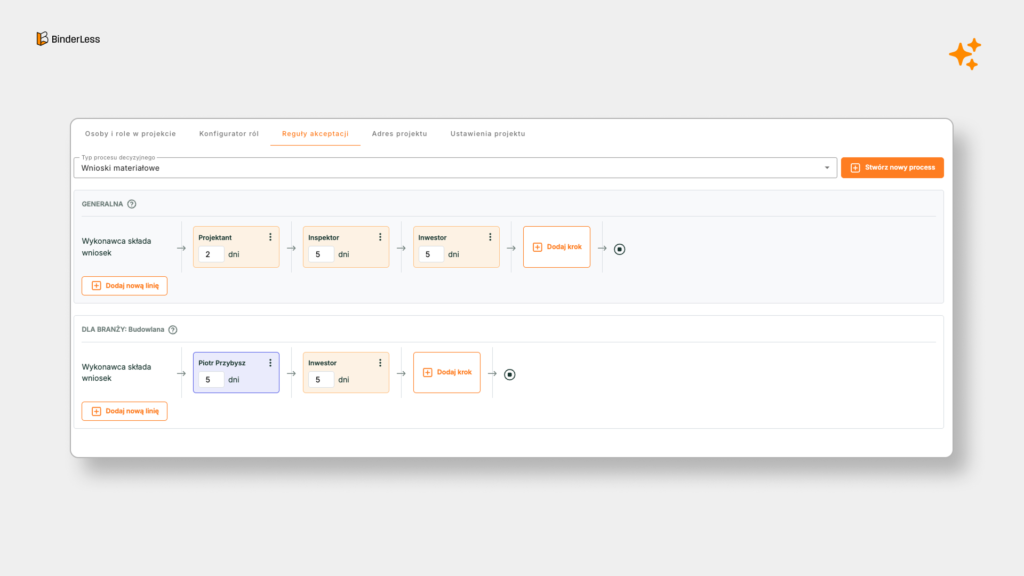
- The Agent only has access to the data that the user on whose behalf the Agent is working has access to, meaning that an inspector only has access to documents relevant to their inspection.
- The Agent restricts access to other projects and organizations, which means that a manager cannot see confidential data from other projects and organizations.
In practice, this means that when a user asks a question, the AI automatically:
- Recognizes which project and section the user is working in.
- Takes into account their role and permissions.
- Searches documents in the CDE, combining answers with the appropriate project context.
- Displays the result along with a document excerpt for immediate answer verification.
This makes the AI Agent a secure, contextual assistant that integrates knowledge from the entire project and delivers it exactly where it’s needed. Without worrying that the response will contain information from another project or that the user will see data they shouldn’t have access to.
BinderLess AI Agent – your Documentation Assistant
In the construction industry, documentation is the heart of the project – it contains decisions, changes, and agreements, but in large projects, its volume makes finding needed information time-consuming. The BinderLess AI Agent solves this problem comprehensively. Through integration with the CDE platform, it utilizes full documentation, analyzes it using LLM and RAG, combines data from various sources (contextual chaining), can interpret text and images (multi-modal reasoning), and pinpoints exactly where in the documents the sought information is located (visual grounding and smart linking).
The Agent checks its answers, corrects them when necessary (self-reflection loop), and remembers the context of previous questions (interactive suggestion / memory). All of this operates within the permissions assigned to users, and data remains secure on EU servers, never entering global models or the internet.
The effect is simple but significant: less time spent searching for information, faster decision-making, reduced errors, and smooth access to project knowledge – exactly when you need it. The Agent doesn’t replace people but streamlines the use of knowledge they already possess.
Converse with your Documentation
With the help of the BinderLess AI Agent, you can talk to your documentation as if it were a team member. Instead of opening dozens of PDF files and clicking through pages, you simply ask:
“What are the allowable tolerances for steel construction in zone C?”
The Agent understands intentions, analyzes documents, and draws conclusions. This allows it to deliver the most relevant information, not random results. It’s not just a new way of working with documentation – it’s a change in the entire flow of information on the construction site.
The Future of AI Agent in Construction – What else Awaits Us?
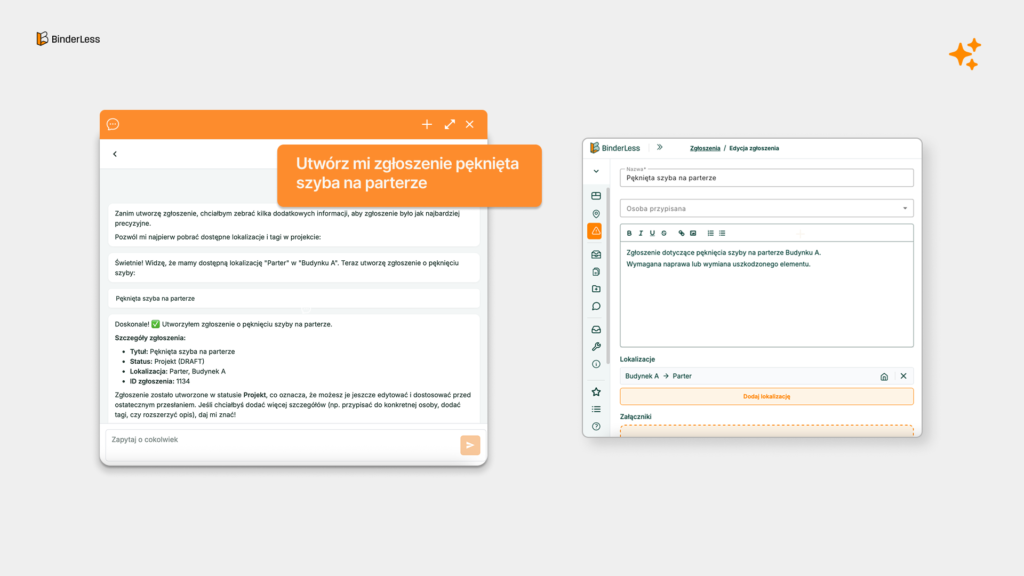
Over the past year, the BinderLess AI Agent has come a long way. Today, it can search all project documentation in natural language, autonomously create reports and defects, respond vocally, access up-to-date information from the internet – such as applicable standards or regulations – and guide the user through the platform like an interactive instruction manual. This is no longer an experiment. It is a tool used daily by construction teams in Poland. But technology does not stand still. Here are the directions that will shape AI in construction in the coming years.
Greater operational autonomy
Today, the Agent creates a report at the user’s command. In the future, it will be able to independently detect inconsistencies in documentation and initiate actions without being asked – for example, flagging missing documents before acceptance or reminding about expiring material certificates. The line between “assistant” and “collaborator” will blur.
Integration with the construction tools ecosystem
We already see that AI in many other fields aims to centralize data in one place, and project documentation is just one of many data streams on a construction site. In the future, we will most likely see connections between various platforms and tools simultaneously, and, importantly, work within the context of the entire project.
Better understanding of technical drawings
This is one of the most difficult problems in AI for construction. A technical drawing is not text – it is an arrangement of lines, symbols, dimensions, and layers that a human learns to read over years. Current AI models perform well when a drawing contains a descriptive table or textual metadata. Vector graphics alone without description still pose a significant challenge. The solution lies in dedicated models trained exclusively on construction data – drawings, plans, sections – that learn to recognize the specifics of this industry. This requires huge datasets and time, but the direction is clear.
Intelligent document filling according to project standards
An Agent that knows the project structure will not only be able to answer questions but also suggest or automatically fill in documents – material requests, acceptance protocols, reports – based on data already present in the system and standards adopted in a given project.
The common denominator of these changes is one: AI ceases to be a search engine and becomes an active participant in the construction process – one that not only knows but also acts.
The AI market in construction is growing at a rate of approximately 25% annually and, according to Fortune Business Insights forecasts, will reach a value of $22 billion by 2032. At the same time, only 12% of construction specialists regularly use AI today – meaning that most of the industry is still facing this change.
Source: Fortune Business Insights, Datagrid – AI Agent Construction Statistics
What else do engineers ask about?
During conversations with project managers and supervision inspectors, the same questions keep coming up. We answer them directly.
Will the AI Agent replace a project manager or supervision inspector?
No. The BinderLess AI Agent is a support tool, not a replacement. A project manager makes decisions, negotiates, assesses risk, and takes responsibility. The Agent eliminates time-consuming information searching in documents – so that people can focus on what requires their experience and judgment.
How long does it take to implement the AI Agent in a construction project?
The Agent is available immediately after logging in, but BinderLess provides each client with 2 hours of implementation to ensure the team works effectively from the start.
Does the AI Agent work on ongoing construction sites, or only on new projects?
The Agent works on all documentation – both for new projects and those already in progress. Simply upload existing documents. The more documentation in the system, the more precise the answers.
What file formats does the BinderLess AI Agent support?
The Agent supports PDF, scans, JPG/PNG images, and text documents. Thanks to built-in OCR, it handles scans, stamps, and handwritten notes without prior file conversion. The Agent reads technical drawings best when they contain a descriptive table – vector graphics alone without textual description may yield imprecise results.
Frequently Asked Questions
Key points to remember regarding the functioning of LLMs and the BinderLess AI Agent.
The global AI market in construction is valued at $4.86 billion (2025) and is projected to grow to $35.53 billion by 2034 (Fortune Business Insights). At the same time, construction remains one of the least digitized industries—in Poland, the digital maturity index stands at just 4.1/10, indicating enormous growth potential.
RAG (Retrieval-Augmented Generation) is an architecture where the AI model does not respond from memory, but first searches actual project documentation, and only then generates a response based on the found fragments. In practice, this means that the BinderLess Agent does not “guess” – every answer is anchored in a specific document, page, or drawing. This eliminates the risk of incorrect answers (hallucinations), which are a common problem for general AI models like ChatGPT.
Yes. The Agent supports voice input — you can ask a question by speaking instead of typing it manually. For a construction manager or inspector, this means access to all project documentation in seconds, without stopping and pulling out a keyboard. Just ask.
Various!
• “What is the diameter of the condensate drain pipe from the air conditioning?”
• “What is the width of the mounting opening for the ventilation grilles?”
• “Will there be new routing of electrical wiring during the renovation?”
• “What are the requirements for construction supervision?”
• “Write how the gas boiler control is planned”
Everything depends on your needs.
Yes, but it may need a moment to process new files—especially large or scanned ones. If the Agent doesn’t find information from a recently uploaded document, wait a few minutes and try again.
Yes — the Agent has agentic capabilities, meaning it can not only respond but also take action. For example, you can write: “Create a report for a cracked tile in room 112 and assign John Smith” — the Agent will execute this action directly on the platform, and you’ll find the report in drafts.
This is normal — AI, much like a new employee, requires context. If the initial response is too general, try specifying: what exactly you are looking for, the relevant industry or project phase, and the purpose of this information. A single clarifying follow-up often makes a significant difference in the quality of the response.
If the Agent did not find the information, try: (1) rephrasing the question using different words or technical synonyms, (2) narrowing the scope — provide a drawing number, industry name, or project stage, (3) checking if the document is uploaded to the platform. The Agent only responds based on uploaded documentation — if the file is not in the system, it cannot provide an answer.
Yes. If you do not have access to a specific folder or document on the platform, the Agent will also not quote its content in responses. Permissions defined by the project administrator also apply at the AI level. Each project operates in an isolated data space. The Agent does not have access to data from other organizations or BinderLess projects.
The agent eliminates hallucinations because it operates using the RAG (Retrieval-Augmented Generation) method, in which the AI model, instead of ‘inventing’ an answer from memory, first searches for specific fragments from your documents and only then formulates the response. Each answer is anchored in the source text, which you can verify. If the Agent cannot find an answer, it will tell you directly. Each answer includes a cited source: the file name, page number, or drawing number, and the highlighted text fragment. You can click on the reference and immediately navigate to the specific location in the document — without manual searching.
No. BinderLess operates in a closed environment — your documents are not sent to the open internet, are not shared with other clients, and are not used for training AI models. Data remains within the BinderLess infrastructure located in the EU.
Yes. With built-in OCR, the Agent reads PDF scans, construction site photos, stamps, signatures, and handwritten notes. You do not need to transcribe or organize documents before uploading them — simply upload them as is.
Yes. The Agent has access to the entire platform: project documents, material requests, Requests for Information (RFIs), change orders, defects, meeting minutes, and locations. It can combine information from different modules into a single response.
ChatGPT works on the open internet or a single uploaded file. NotebookLM is manually connected to selected documents. BinderLess AI Agent works fully integrated with all your documentation on the platform — all versions, folders, submittals, RFIs, and notes simultaneously, and works exclusively on the documentation of a specific construction project. Unlike ChatGPT or NotebookLM, it does not require manual file uploads, understands project structure, document versions, and user roles, and provides every answer with its source.
In this article

Taking over a construction project at a critical moment means battling document chaos and lack of knowledge about previous decisions. See how during the municipal swimming pool construction in Sulejówek, a digital database and OCR technology enabled reconstruction of the project history, avoidance of costly errors, and stress-free preparation of complete as-built documentation.
In a world where email and Excel are no longer sufficient, SIM Łódzkie demonstrates how digitalization genuinely accelerates social housing construction. Thanks to the BinderLess platform, decision-making time has been reduced from days to hours, and 540 apartments and 9317 documents remain under full control. See how a public company transformed chaos into an advantage and why today no one wants to return to old methods.

In the era of digitalization in the construction industry, the Common Data Environment (CDE) is becoming a key tool supporting processes.